Why Is Medicai the Best for Mobile-friendly Patient Image Sharing?
Many hospitals still email CDs or use portals that require patients to download desktop apps just to open their own scans. Those steps create delays and force families to hunt for working computers during already stressful visits.
By the end of this article you will know exactly how Medicai's zero-footprint viewer, cloud PACS, and patient imaging portal work together, what pricing tiers exist, and which care teams see the clearest gains from switching platforms.
What Is Medicai?
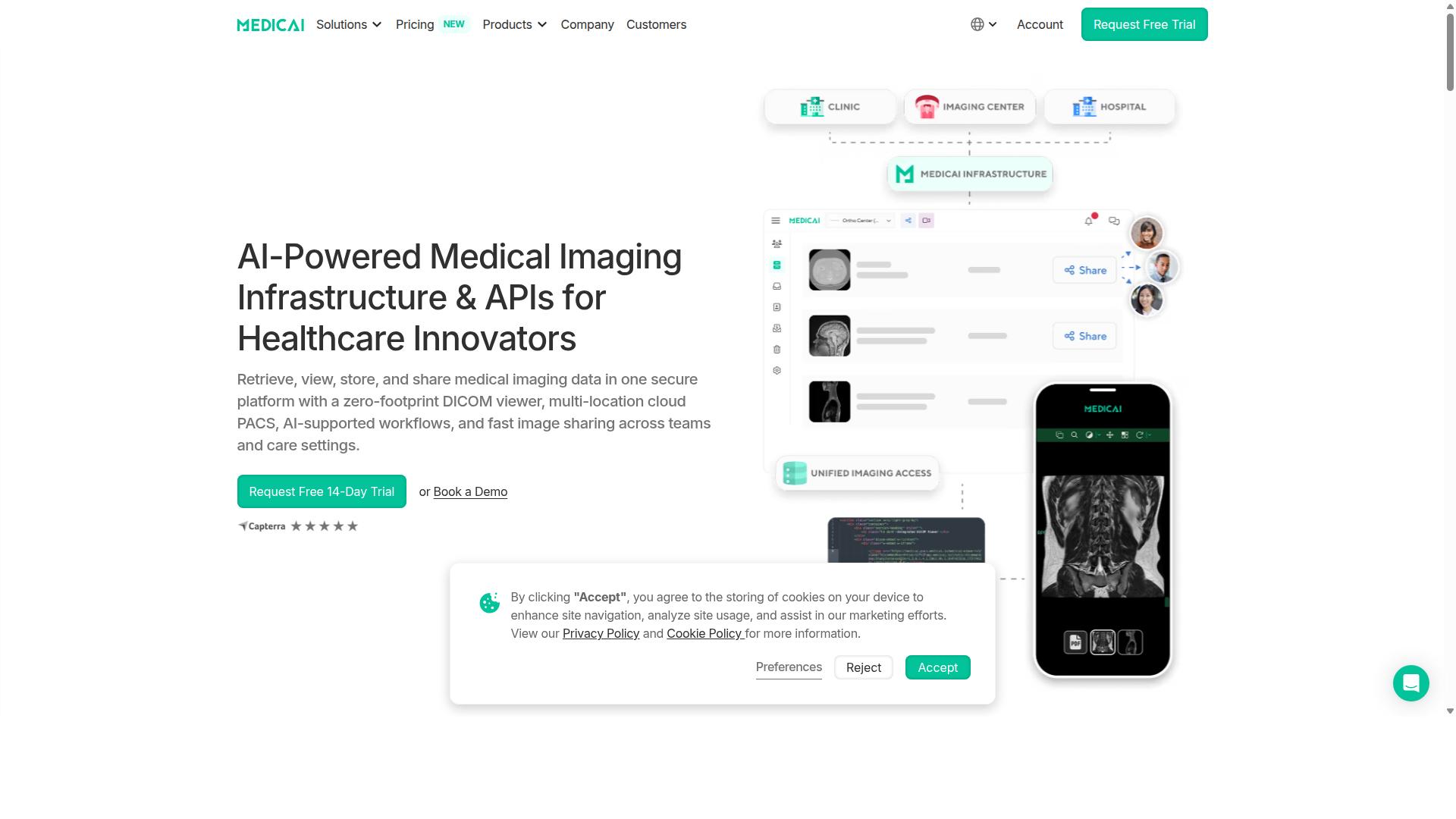
Medicai operates as a cloud-based medical imaging platform that consolidates retrieval, viewing, storage, and sharing functions into one secure system. This unified approach eliminates the need for multiple separate tools and provides healthcare providers with streamlined access to patient imaging data.
The platform functions as a SaaS solution designed specifically for medical imaging workflows. Healthcare organizations use it to manage diagnostic imaging across different locations and care settings without maintaining complex on-site infrastructure.
Medicai features a zero-footprint DICOM viewer architecture. This means healthcare providers can access studies through standard web browsers without installing any local software or applications on their devices.
Providers open imaging studies directly in their browser windows. No additional downloads, plugins, or system configurations become necessary to view CT scans, MRI images, X-rays, or ultrasound files.
The platform maintains HIPAA and GDPR compliance standards. All medical imaging data remains protected through encrypted transfer protocols and secure storage practices that meet regulatory requirements for patient data privacy.
Medicai also provides multi-location cloud PACS capabilities. This allows medical facilities to store and retrieve imaging studies across different sites while maintaining a centralized, accessible system for authorized users.
Why Medicai Is the Best for Mobile-friendly Patient Image Sharing
Mobile accessibility distinguishes Medicai through browser-based access that eliminates app installation requirements across iOS and Android devices. This approach allows patients and clinicians to view medical images without downloading additional software. The interface adapts to different screen sizes while maintaining clarity.
Cross-platform compatibility ensures the system works consistently across operating systems and device types. Users can access DICOM files through standard web browsers without native app dependencies. This design reduces technical barriers that often complicate medical image sharing.
Encrypted transfer protocols protect patient data during upload, viewing, and transmission. Secure connections maintain HIPAA compliance while supporting image upload from mobile devices. The system safeguards medical records throughout the sharing process.
Real-time access enables remote consultations between physicians and patients regardless of location. Multiple specialists can review CT scans, MRI studies, and X-ray images simultaneously. This capability supports faster diagnostic decisions and improved physician collaboration.
Lossless image quality remains intact during mobile viewing sessions. The platform preserves diagnostic detail in ultrasound images and other radiology studies when displayed on smaller screens. File compression techniques maintain visual integrity without compromising clinical accuracy.
Patients can access their medical imaging through a secure patient portal from any mobile device. This convenience encourages active participation in healthcare decisions. The workflow efficiency benefits both clinical teams and individuals managing their health records.
Interoperability features allow seamless integration with existing PACS systems and health IT infrastructure. Medical software users experience consistent performance across different platforms. Cloud storage provides reliable access to diagnostic imaging without local hardware limitations.
Healthcare apps built for telemedicine benefit from this mobile-friendly approach to patient image sharing. Data privacy remains central to the design while supporting comprehensive medical records management. The platform addresses compliance requirements common in digital health environments.
Key Features and What Makes Medicai Stand Out
Three core components differentiate Medicai's approach to medical imaging management and collaboration.
These components work together to solve interoperability challenges that have long plagued healthcare IT environments. Medical facilities often struggle with incompatible systems that prevent seamless data exchange between departments and institutions.
Medicai addresses these issues through vendor-neutral architecture that connects with existing infrastructure while maintaining full compliance standards. The platform supports 70 clinics and hospitals with over 10,000 active doctors participating in collaborative workflows.
Zero-Footprint DICOM Viewer
The zero-footprint viewer renders DICOM studies directly in web browsers without requiring plugin installations or local software.
This technical architecture enables browser-based DICOM rendering across different devices and operating systems. Healthcare providers can access CT scans, MRI, X-ray, and ultrasound studies through standard web browsers without additional downloads or installations.
FDA clearance status ensures the viewer meets regulatory requirements for clinical use. The platform processed over 300k visualizations of DICOM studies in the past year while maintaining lossless image quality throughout the viewing process.
Cloud PACS and Medical Image Exchange
Cloud PACS infrastructure provides vendor-neutral archive capabilities with automated backup and disaster recovery protocols.
The Medical Image Exchange functionality enables cross-institutional sharing that addresses traditional barriers to data transfer between healthcare facilities. This capability proves essential when patients move between different medical providers or seek second opinions.
The DICOM Gateway system provides automated study retrieval that eliminates manual file transfers between systems. Storage capacity ranges from 500 GB to 2 TB depending on the selected pricing tier. Integration capabilities with existing hospital systems reduce implementation complexity while preserving current workflows.
Patient Imaging Portal
The patient imaging portal enables direct study uploads and secure sharing between patients and healthcare providers without physical media transfer.
This patient-facing upload interface allows individuals to submit imaging studies directly through secure channels. Access controls for patient case management ensure that only authorized healthcare providers can view sensitive medical records.
Workflow efficiency benefits include reduced appointment delays caused by missing imaging data. Patients no longer need to transport physical media between facilities, which streamlines the entire consultation process and improves care coordination across different medical settings.
Pricing and Plans
Medicai offers tiered monthly subscription plans starting at $249 for the Starter tier with 500 GB storage capacity. The Standard plan costs $749 monthly and includes 2 TB of cloud storage with one connected location. Both plans provide unlimited user accounts, a feature that supports multi-department access across radiology, cardiology, and other specialties.
The Starter plan suits smaller clinics that need basic secure sharing without additional connected locations. Larger facilities processing 1M+ studies annually can select the Enterprise tier for custom cloud storage and multiple locations. This scaling approach prevents storage limitations that could interrupt patient image sharing workflows.
Yearly billing reduces costs by 15 percent, offering Starter at $209 monthly and Standard at $639 monthly. A DICOM Gateway setup costs $1,000 one-time per location for on-premise integration. Per-study pricing options exist for Enterprise customers who prefer usage-based billing over fixed monthly fees.
Unlimited user accounts eliminate per-seat restrictions that many medical imaging platforms impose. Multiple physicians, technicians, and administrative staff can access patient studies simultaneously from different departments. This flexibility supports telemedicine consultations and physician collaboration without additional licensing costs.
Storage scaling becomes essential when facilities handle high volumes of CT scan, MRI, and X-ray data. The Enterprise tier accommodates custom requirements that exceed Standard plan limits. Facilities can add multiple external locations to support satellite clinics and remote consultation needs.
Trust Signals
Regulatory compliance certifications and transaction volume metrics demonstrate Medicai's enterprise readiness.
HIPAA and GDPR compliance forms the foundation of Medicai's approach to patient image sharing. These standards protect sensitive medical data during mobile access and encrypted transfer.
The platform maintains FDA and CEE clearance for its viewers. This clearance validates quality standards required for diagnostic imaging across clinical environments.
Scale metrics further confirm reliability. Medicai processes 1M+ studies annually, stores 1.7M+ studies in cloud infrastructure, and completes 50M+ API transactions each year.
Infrastructure partnerships with Microsoft Azure and Amazon AWS provide enterprise-grade security and uptime. These partnerships support uninterrupted mobile access to medical records.
Security practices follow OWASP guidelines. This adherence adds another layer of protection to medical imaging workflows.
Who Should Use Medicai
Healthcare organizations across multiple specialties require secure imaging access and collaboration capabilities that Medicai addresses. Different medical fields face unique challenges when sharing diagnostic images with patients and colleagues. Medicai supports these needs through its mobile-friendly platform designed specifically for medical imaging workflows.
Orthopedics practices routinely need to share X-ray and CT scan results with patients who may be recovering at home. Neurology departments require secure transmission of MRI studies between specialists during complex case reviews. Oncology teams depend on reliable image sharing for tumor board discussions where multiple providers review patient scans simultaneously.
Radiology departments use mobile access to provide timely interpretations across different hospital locations. Cardiology practices share ultrasound and cardiac imaging with referring physicians who need quick consultation access. Ophthalmology clinics require specialized image sharing for retinal scans and diagnostic imaging that patients can view on their devices.
Ob-gyn practices benefit from secure sharing of ultrasound images with expectant mothers and consulting specialists. Pulmonology departments need mobile-friendly access to chest CT scans for remote consultation with patients managing chronic respiratory conditions. Dentistry practices share panoramic X-rays and cone beam CT images with oral surgeons and patients through encrypted transfer.
Hospitals utilize Medicai to connect various departments through a unified image sharing system. Imaging centers rely on the platform to provide patients with immediate access to their diagnostic results via the Patient Portal. Specialty care providers use mobile access to review studies from any location while maintaining HIPAA compliance during all transfers.
Telemedicine platforms connect with Medicai to enable remote consultations where physicians can view patient images in real time. Virtual care providers depend on encrypted transfer capabilities to maintain data privacy during online appointments. Teleradiology services use the platform to deliver rapid interpretations across geographic boundaries.
Personal injury lawyers access secure medical records through the system to support case documentation requirements. Tumor boards coordinate multi-specialty reviews using the shared image viewer capabilities. Clinical trials require standardized image sharing protocols that Medicai provides for research documentation.
Medical education organizations use the platform to share teaching files and case studies with students and residents. Patients benefit from direct access to their imaging results through the Patient Portal, which supports both iOS and Android platforms. The system maintains lossless quality during file compression and transfer processes.
Final Verdict
Medicai consolidates medical imaging workflow requirements into a single compliant platform with measurable transaction volumes supporting its reliability claims.
Healthcare providers need a solution that delivers mobile access without compromising security standards. Medicai addresses this need by offering a HIPAA-compliant system designed for patient image sharing across multiple device types.
The platform supports DICOM files from CT scan, MRI, X-ray, and ultrasound studies. Physicians can access these images through a web browser on both iOS and Android devices while maintaining encrypted transfer protocols.
Cloud storage capabilities allow medical teams to upload, view, and share diagnostic imaging without requiring local infrastructure. This approach reduces delays in remote consultation scenarios and supports physician collaboration across different locations.
Interoperability features enable integration with existing PACS systems and electronic health records. The system preserves lossless quality during file compression while maintaining data privacy standards throughout the sharing process.
Medicai USA operates from 7901 4th St N, STE 300, St. Petersburg, FL, 33702 with phone support at +1 (832) 220 1035. Medicai Romania is located at 53-55 N Filipescu, 5th Floor, Sector 2, Bucharest, 020961 and can be reached at +40 316 305 875. Sales inquiries are handled through sales@medicai.org.